Aviation Conflict-Event Tempo, July 2026: Iran's Peak Rolls Over, the Signal Broadens
Iran's aviation conflict-event tempo has crested — its share of aviation-tagged conflict events peaked at 14.3% in mid-July, then fell to 7.1% by the week of 27 July. But AeroVigil's own armed-conflict classification signal did not fall with it; it rose, and broadened across more theatres.
Iran's aviation conflict-event tempo has crested. In AeroVigil's pipeline, Iran's share of all aviation-tagged conflict events climbed to a second, higher peak of 14.3% in the week of 13 July, then fell for two straight weeks — to 11.8% and then 7.1% by the week of 27 July. That is the double peak rolling over. But the broader armed-conflict signal did not fall with it. AeroVigil's own classification pipeline shows armed conflict rising as a share of all classified intelligence, from 4.5% in mid-July to 5.8% and 5.6% in the two weeks that followed, while Iran's slice of that signal shrank. The headline theatre is cooling; the underlying signal is broadening.
Data window: 1 June – 2 August 2026 (nine complete Monday-start weeks). Sources: AeroVigil's intelligence pipeline (normalized intelligence items and their risk classifications) and GDELT aviation-tagged conflict events ingested into the same pipeline. The pipeline's total ingest volume grew across the window, so every cross-week comparison below uses a share or ratio metric, or is indexed to a fixed base week — never a raw count presented as a world trend. See the methodology footer.
How did last month's forecasts hold up?
This is the fourth issue of AeroVigil's monthly trend-and-forecast series, so it opens by grading the July issue's three forecasts against the data that has since arrived. Only part of each forecast's window has elapsed, so some grades are open — and one cannot be scored honestly at all. Saying so is the point of keeping a scorecard.
Forecast 1 — "The Iran tempo re-escalation does not immediately re-revert" (likely). Status: open, on a knife's edge. The forecast said Iran's weekly tempo share would stay at or above 8% in a majority of the complete weeks from 20 July to 16 August, and would be disconfirmed by a majority printing below 8%. Two of those weeks are now complete: 11.8% in the week of 20 July (above the line) and 7.1% in the week of 27 July (below it). The count stands at one and one, with two weeks left to decide it.
Forecast 2 — "The tempo–footprint gap narrows" (even chance). Status: not scoreable — instrument degraded. This forecast depended on the contested-airspace classification footprint, expressed as a share of weekly classified items. That series is no longer measurable on reliable data: the volume of items carrying a contested-airspace classification thinned sharply after the week of 13 July, so any share computed for the forecast window would be built on a denominator too small and unstable to trust. AeroVigil will not grade a forecast on an instrument it knows to be degraded. The forecast is left open, and the limitation is logged. This is exactly why the desk tracks several independent signals rather than one.
Forecast 3 — "Iran holds the top single-theatre tempo share" (highly likely). Status: hit so far, but the margin has collapsed. In both complete weeks, Iran remained the highest-share single theatre: 11.8% to Ukraine's 5.1% in the week of 20 July, and 7.1% to Ukraine's 5.7% in the week of 27 July. Iran still leads. The lead, however, has narrowed from 9.4 points at the July peak to 1.4 points by the end of the month.
Has Iran's conflict-event tempo peaked?
On this data, yes — the second peak has crested and is decaying. Iran's share of weekly aviation-tagged conflict events ran 6.8%, spiked to 13.5% in the week of 8 June, reverted to a ~5% floor for three weeks, then re-escalated to a higher second peak of 14.3% in the week of 13 July. It has since fallen two weeks running, to 11.8% and 7.1%.
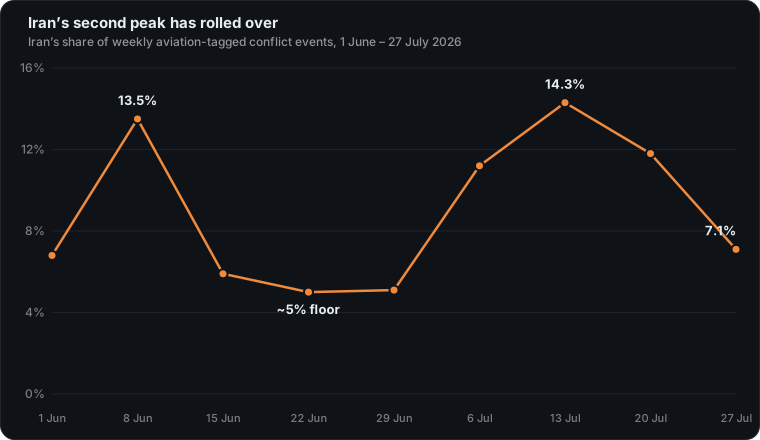
Share is the honest metric. AeroVigil's total ingest volume grew across the window, so a raw event count would mostly measure the pipeline, not the world. Iran's share of all aviation conflict events is robust to that growth: if the whole pipeline doubles and Iran doubles with it, the share is flat. It did not stay flat — it rose to a peak and is now falling. That is a real change in Iran's proportional weight in the aviation-conflict signal, not an artefact of a bigger pipeline. One caution carries over from last month: a single decline is not proof the driver has gone away. Iran has now reverted from a peak twice, and re-escalated once.
Is the Iran–Ukraine gap closing?
Yes, and quickly. Through June and early July, Iran's tempo swung between roughly 5% and 14% while Ukraine held a narrow, stable band between 4% and 6%. As Iran's second peak decayed, the two theatres converged. In the week of 27 July, Iran sat at 7.1% and Ukraine at 5.7% — a gap of just 1.4 points, the narrowest since the two theatres briefly crossed in late June.
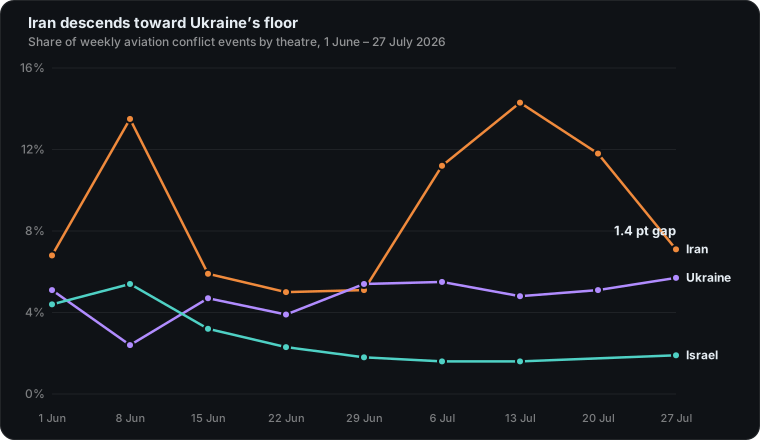
Ukraine is the steady background theatre whose share never spikes and never collapses. Israel has faded from 5.4% in the week of 8 June to about 1.9% by late July. The picture is one of convergence at the top: Iran descending toward Ukraine's floor rather than Ukraine rising to meet Iran. Whether that convergence resolves into another Iran re-escalation or a genuine Ukraine-led handover is the open question this issue's forecasts try to pin down. A one-week ranking remains a data point, not a trend — the lesson last month's scorecard taught the hard way.
Why is the armed-conflict signal rising while Iran's tempo falls?
Because the two are different instruments measuring different things, and in late July they diverged. Indexed to the week of 29 June, Iran's GDELT tempo share rose to 275 and then fell back to 137. Over the same weeks, AeroVigil's own armed-conflict classification share climbed steadily to 147 and held at 142. One instrument is rolling over; the other is grinding up.
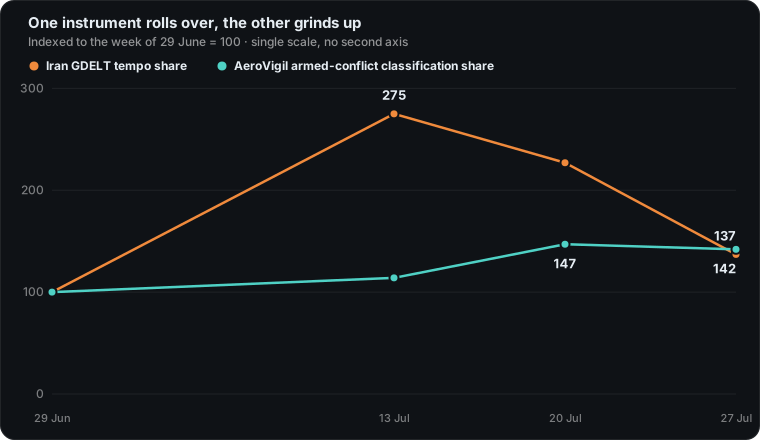
The mechanism is breadth, not intensity. The GDELT tempo series measures where aviation-conflict reporting concentrates, and reporting concentrated heavily on Iran through mid-July. AeroVigil's armed-conflict classification share measures how much of all classified intelligence carries an armed-conflict disposition, across every theatre at once. As that share rose in late July, Iran's portion of it fell — from 29.8% of armed-conflict items in the week of 13 July to 24.3% and then 23.8% — while the number of distinct countries touched by armed-conflict items held steady in the low thirties each week. The signal did not intensify around Iran. It spread away from it.
Correlation is not causation, and these two series are not interchangeable. The tempo tells you where the headlines are. The classification share tells you how broad the underlying conflict signal is. In late July they pointed in opposite directions — the headline theatre cooled while the overall footprint widened — and reading either one off the other would have missed the story. For flight operations, that gap is the whole argument for tracking reporting concentration and classification breadth as separate signals.
What does this mean for the threat picture and the technology to track it?
The threat vector is conflict-zone overflight risk: airspace where military activity, air-defence posture, or GNSS jamming and spoofing can degrade the safety of an overflight even when no single incident dominates the news. A broadening armed-conflict signal is precisely the case that single-theatre, event-driven monitoring handles worst. An operator watching only the Iran headline in late July would have seen the tempo falling and concluded the conflict signal was easing. The pipeline shows the opposite: the signal was widening across more theatres at the same moment.
The mitigation is continuous, multi-theatre classification rather than headline tracking. AeroVigil's pipeline attaches a disposition to each intelligence item and tracks the armed-conflict footprint across all theatres independently of which one is dominating the reporting cycle — which is what let this analysis see Iran cool while the broader signal rose. That durable disposition is the input a pre-flight risk assessment workflow turns into a decision, converting a volatile, single-theatre event-tempo series into a trackable, cross-theatre airspace posture. The mechanics of that posture — prohibited versus restricted airspace, the role of NOTAMs, and why a single open-source report is not an alert — are covered in our guide to conflict-zone and overflight risk and in the glossary.
The current status of any specific airspace is volatile and is not frozen in this article. For the live disposition — whether overflight is advisable today, and at what flight levels — consult the continuously updated flight-risk feeds rather than any figure here.
Forecasts
These assessments use a fixed probability yardstick, defined once in the methodology footer. Each is falsifiable, with the disconfirming observation and a deadline stated.
Forecast 1 — Iran's tempo does not re-test its July peak (likely). Iran's weekly aviation conflict-event tempo share will stay below 12% in every complete week of the window 3–30 August 2026, rather than printing a third peak near its 14.3% July high. Disconfirmed if Iran's share reaches 12% or higher in any complete week in that window.
Forecast 2 — The Iran–Ukraine gap stays narrow (even chance). Ukraine will come within 3 points of Iran's weekly tempo share, or lead it outright, in a majority of the complete weeks from 3 to 30 August 2026. Disconfirmed if Iran leads Ukraine by more than 3 points in a majority of those weeks.
Forecast 3 — The broadening holds (likely). AeroVigil's armed-conflict classification share will stay at or above 5.0% of classified intelligence in a majority of the complete weeks from 3 to 30 August 2026, rather than snapping back to its ~4% June floor. Disconfirmed if the share prints below 5.0% in a majority of those weeks. Live ground-truth airspace status remains at the flight-risk feeds.
Frequently asked questions
Does a falling event tempo mean the airspace is safer?
Not on its own. Event tempo is a reporting-concentration signal, not an airspace ruling. In late July, Iran's tempo fell while AeroVigil's broader armed-conflict classification share rose and spread across more theatres. The safety question depends on NOTAMs, flight-level restrictions and current avoidance practice — consult the live flight-risk feeds.
What is the difference between the tempo signal and the classification share?
Event tempo is the rate of aviation-conflict reporting tied to a single theatre. The armed-conflict classification share is how much of all classified intelligence, across every theatre, carries an armed-conflict disposition. The first tells you where the headlines are; the second tells you how broad the underlying signal is. In late July they moved in opposite directions.
Why did AeroVigil leave one of last month's forecasts ungraded?
Because the signal it depended on degraded. The contested-airspace classification series thinned in the back half of the window, leaving a denominator too small to compute an honest share. Grading a forecast on unreliable data would be worse than leaving it open. The limitation is logged, and the desk relies on its other independent signals in the meantime.
Is this an event-driven brief about a specific incident?
No. This is a trend analysis of how conflict-event tempo and armed-conflict classifications moved across a defined window, with falsifiable forecasts. AeroVigil publishes same-week event briefs separately.
Methodology
This article draws only on AeroVigil's own intelligence pipeline and the open-data GDELT aviation event stream ingested into it. No third-party proprietary feeds are republished.
Window and pipeline-growth control. The data window is 1 June – 2 August 2026 (nine complete Monday-start weeks). Because the pipeline's total ingest volume rose across the window, every cross-week comparison uses a share or ratio metric, or is indexed to a fixed base week — never a raw count presented as a world trend. Tempo series are pinned to a single fixed source (GDELT aviation-tagged conflict events) ingested across the whole window; the armed-conflict series is expressed as a share of all classified intelligence items, a classification field populated for every item in the window.
A note on severity versus frequency. All aviation-tagged conflict events in the pipeline sit near the floor of the GDELT Goldstein intensity scale, so the tempo metric measures the frequency and concentration of high-intensity conflict reporting, not week-to-week changes in event severity. It is a reporting signal, not a casualty count.
Probability yardstick. Highly likely ≥ 80%; likely 60–80%; even chance ~50%; unlikely 20–40%; highly unlikely ≤ 20%.
Source grading. AeroVigil grades sources on a five-tier reliability model; a single open-source report is treated as a lead, not a confirmed alert. See our methodology for the full approach to source reliability, analyst-in-the-loop verification, and classification.
_Last reviewed: 3 August 2026._