What Is Conflict Zone Airspace Risk? Overflight Risk Explained
Conflict zone airspace risk is the danger civil aircraft face when flying over or near areas of armed conflict — from surface-to-air missiles to GPS jamming. Here is how the risk arises, who warns about it, and how operators decide.
On this page · 9
- Why is overflying a conflict zone dangerous?
- How is conflict zone risk communicated to operators?
- Who decides whether to fly over a conflict zone?
- What role does altitude play?
- How has the threat picture changed recently?
- Frequently asked questions
- What is the difference between overflight risk and conflict zone risk?
- Can an airline be liable for flying over a conflict zone?
- Does GPS jamming cause crashes?
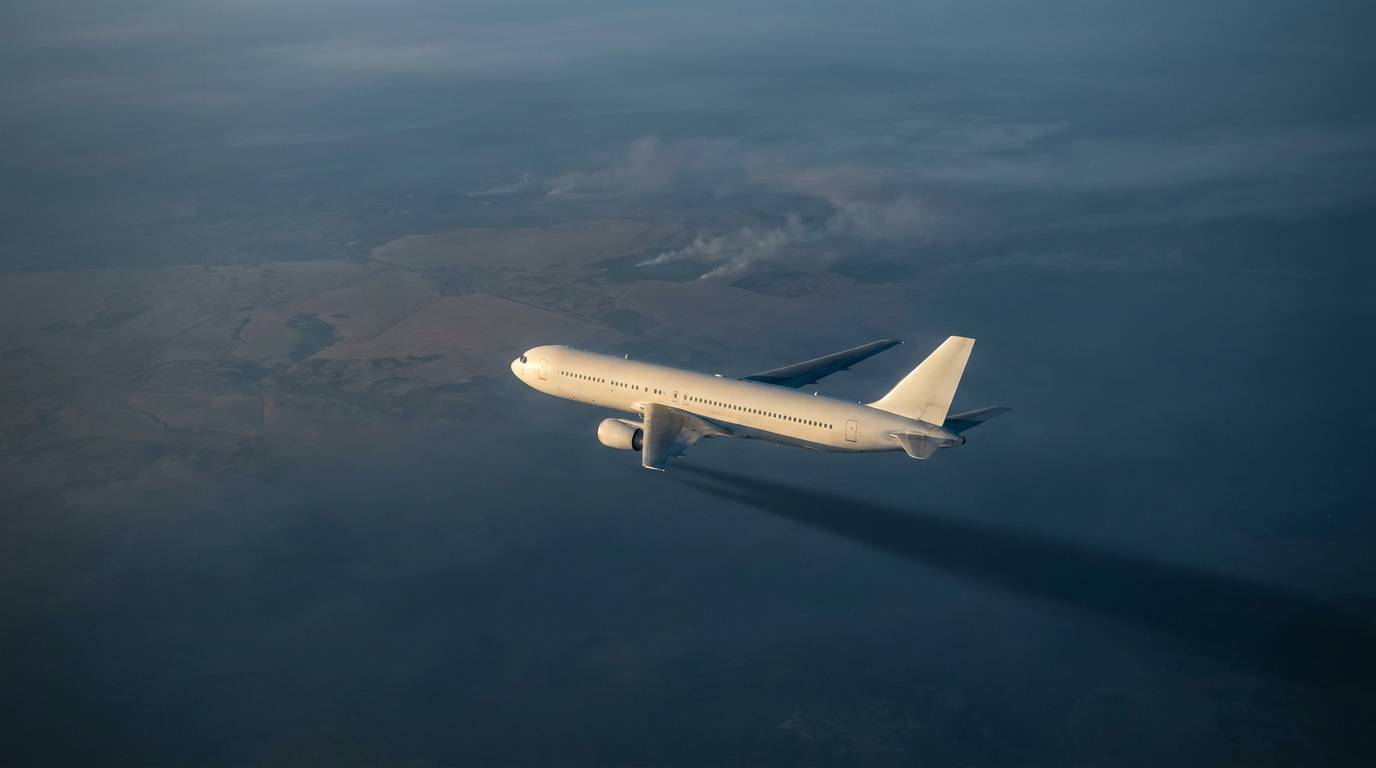
Conflict zone airspace risk — often called overflight risk — is the danger a civil aircraft faces when transiting airspace over or near an area of armed conflict. The threats range from deliberate or accidental engagement by surface-to-air weapons to GPS jamming and spoofing. Crucially, the aircraft is never meant to land there; it is simply passing through, often at cruising altitude.
Why is overflying a conflict zone dangerous?
A cruising airliner is, to a misidentifying air-defence operator, just a radar track at altitude. The catastrophic losses of civil aircraft over conflict zones — Malaysia Airlines MH17 over eastern Ukraine in 2014, and Ukraine International Airlines PS752 near Tehran in 2020 — were both the result of military weapons engaging civil aircraft, not accidents in the conventional sense.
The core hazards are:
- High-altitude surface-to-air missiles (SAMs) that can reach cruising altitude, typically operated by state or sophisticated forces.
- MANPADS — shoulder-launched missiles that threaten aircraft at lower altitudes, near departure and arrival.
- Misidentification during periods of heightened military alert, when civil traffic can be mistaken for a threat.
- GPS jamming and spoofing that degrades or falsifies navigation, increasingly widespread around active conflicts.
How is conflict zone risk communicated to operators?
No single authority dictates a global no-fly answer. Instead, several overlapping channels publish warnings:
- ICAO Conflict Zone Information Repository — a central place where states share advisories about risks in specific airspace.
- State advisories — national bodies such as the FAA (US), EASA (EU, via Conflict Zone Information Bulletins), and the UK DfT publish guidance for their operators.
- NOTAMs — including airspace closures and prohibitions issued by the controlling state itself.
A complication: these sources do not always agree. One state may prohibit its carriers from a region while another stays silent. This divergence is exactly why operators cannot simply defer to a list — they must form their own assessment.
Who decides whether to fly over a conflict zone?
The operator. A state can close its own airspace, but it cannot compel foreign operators to avoid airspace that remains technically open. That places the decision — and the liability — squarely with the airline.
In practice, the decision flows through a structured process:
- Gather all available advisories and intelligence for the airspace.
- Assess altitude exposure, the weapons threat, and available alternative routes.
- Weigh the result against the operator's risk appetite.
- Document the decision so it can be justified later.
This is where aviation security intelligence and a flight risk assessment tool become essential: they turn a sprawling, contradictory information set into a single, defensible call.
What role does altitude play?
Altitude is central. Most overflight risk assessments are altitude-banded: airspace might be considered acceptable above a certain flight level but prohibited below it, because different weapons reach different heights. A route that is safe at FL360 may be unacceptable during the climb and descent near a threatened airport. Good assessments therefore consider not just whether to enter airspace but at what altitude.
After MH17, the principle shifted decisively: open airspace is not the same as safe airspace, and the burden is on the operator to prove it considered the risk.
How has the threat picture changed recently?
Three trends have intensified the problem. Simultaneous conflicts — in Eastern Europe, the Middle East and the Sahel — have multiplied the number of regions to monitor. GPS jamming has spread far beyond active front lines, affecting routine routes. And the pace of change has accelerated: airspace can be closed, reopened or re-threatened within hours, faster than periodic manual reviews can track.
The response is continuous monitoring rather than static route approvals — re-evaluating exposure as the situation evolves, not just at the planning stage.
Frequently asked questions
What is the difference between overflight risk and conflict zone risk?
They are closely related. Conflict zone risk is the underlying hazard created by armed conflict; overflight risk is that hazard as it applies specifically to aircraft transiting the airspace rather than landing.
Can an airline be liable for flying over a conflict zone?
Yes. Because the decision rests with the operator, regulators, insurers and courts can scrutinise whether it took reasonable steps to assess and mitigate the risk — which is why documentation matters.
Does GPS jamming cause crashes?
On its own, modern aircraft have redundant navigation, so jamming is usually a degradation rather than an immediate danger. The greater concern is spoofing, which can feed false positions, and the loss of situational awareness near already-threatened airspace.
For the underlying discipline, read What is aviation security intelligence?. For unfamiliar terms, see the aviation security glossary.