What Is a Flight Risk Assessment Tool (FRAT)?
A Flight Risk Assessment Tool (FRAT) is a structured method for scoring the cumulative risk of a specific flight before departure. Learn what factors it weighs, why regulators expect it, and how automated FRATs differ from paper checklists.
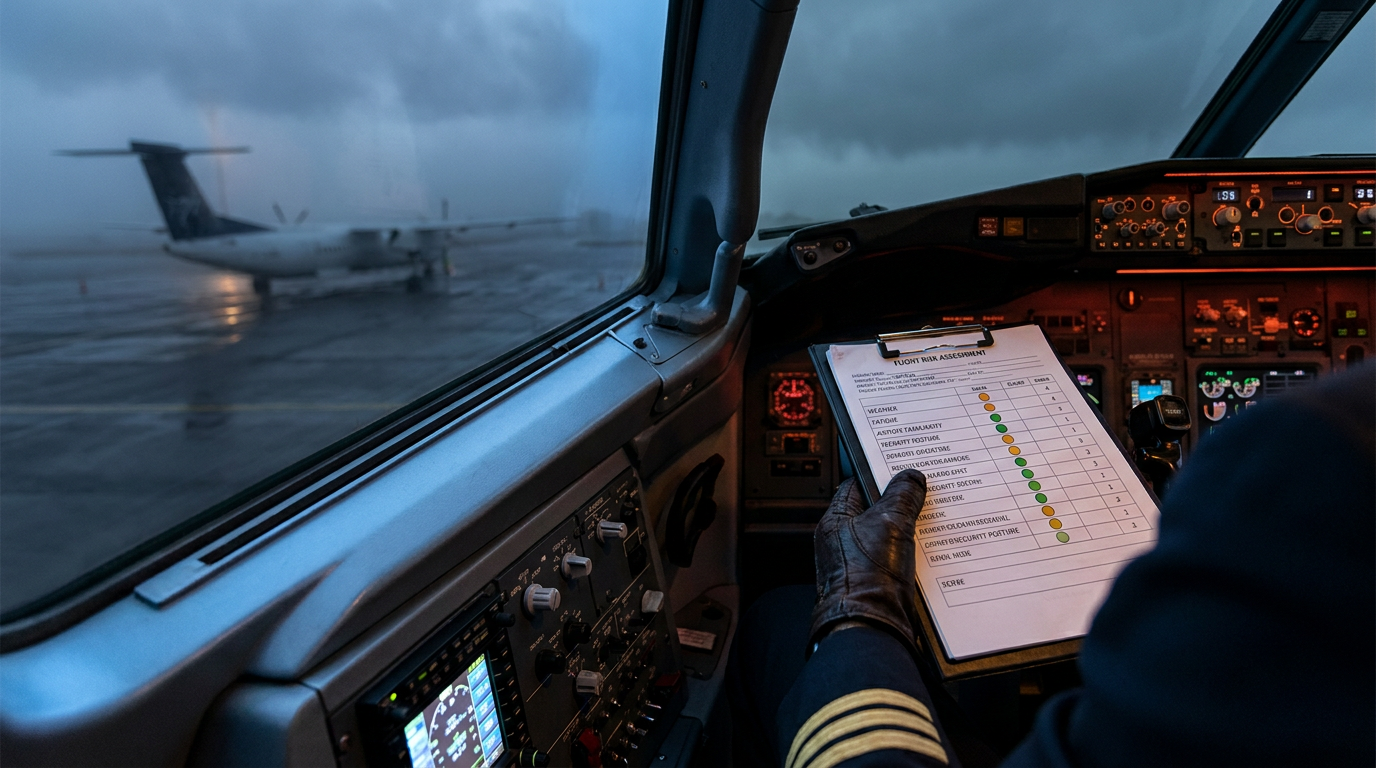
A Flight Risk Assessment Tool (FRAT) is a structured method for measuring the cumulative risk of a specific flight before it departs. Instead of relying on a pilot's gut feeling, a FRAT scores individual risk factors — weather, crew fatigue, airport conditions, destination security — and combines them into a single number that can be compared against a defined threshold.
Why do operators use a FRAT?
Most aviation accidents are not caused by one catastrophic failure but by an accumulation of smaller factors — a tired crew, marginal weather, an unfamiliar airport, all on the same night. Individually each is manageable; together they can exceed what is safe. A FRAT exists to make that accumulation visible before the flight, when there is still time to act.
It does three things a pilot's judgement alone cannot reliably do:
- Standardises the assessment so every flight is evaluated the same way.
- Documents the decision, creating a record for safety management and regulators.
- Triggers mitigation — when a score crosses a threshold, it forces a defined response rather than leaving it to discretion.
Is a FRAT required by regulation?
A FRAT is the practical expression of the risk-management obligation in a Safety Management System (SMS), which ICAO Annex 19 requires operators to maintain. While the rules rarely mandate the word FRAT, they do require operators to identify hazards and manage risk systematically — and a FRAT is the standard tool for doing so at the level of an individual flight. For business and charter operators in particular, a documented FRAT has become an expected norm.
What factors does a FRAT assess?
The exact list varies by operator, but most FRATs weigh four broad categories:
- Crew factors — recent duty and rest, fatigue, experience on the aircraft type and into the specific airport.
- Environmental factors — weather, visibility, crosswinds, day or night, and contaminated runways.
- Airport and route factors — terrain, approach difficulty, runway length, and airport familiarity.
- Threat and security factors — destination security posture, conflict zone exposure, and civil unrest.
Each factor is scored and weighted; the scores combine into a total. This is where the FRAT meets aviation security intelligence — the security factors are only as good as the threat picture feeding them.
How does scoring work?
A typical FRAT assigns points to each risk factor and sums them. The total falls into a band — commonly something like:
- Low / green — proceed normally.
- Elevated / amber — proceed only with specified mitigations and, often, sign-off from a duty manager.
- High / red — do not proceed without senior authorisation, or do not proceed at all.
The thresholds encode the operator's risk appetite. The point is not the number itself but the action it triggers: a FRAT is only useful if a high score reliably changes what happens next.
A FRAT does not make the decision. It makes the decision visible, consistent and accountable — so that accepting risk is a conscious choice, not an oversight.
Paper FRAT vs automated FRAT
Early FRATs were paper or spreadsheet checklists filled in by the crew. They work, but they share weaknesses: the data is only as current as the person entering it, security inputs are often guessed, and the records are hard to analyse across a fleet.
Automated, data-driven FRATs address this by pulling live inputs — weather, NOTAMs, airspace status, destination threat intelligence — directly into the assessment. That removes manual lookup, keeps the security picture current, and produces structured records the safety team can trend over time. The crew still applies judgement; the tool ensures they are judging against accurate, complete information.
Frequently asked questions
What does FRAT stand for?
Flight Risk Assessment Tool. Some operators use FRA (Flight Risk Assessment) for the same concept.
Who fills out the FRAT?
Traditionally the pilot in command or dispatch, before departure. In automated systems, much of it is pre-populated from live data and the crew reviews and confirms it.
Is a FRAT only about safety, or also security?
Both. A modern FRAT incorporates security factors — destination threat, overflight risk, unrest — alongside traditional safety factors like weather and fatigue.
To understand the threat inputs a FRAT depends on, read What is aviation security intelligence? and What is conflict zone airspace risk?. For terminology, see the glossary.