ICAO Annex 17 Requirements: What States, Airports and Operators Must Do
ICAO Annex 17 assigns concrete, enforceable obligations to States, airports, and aircraft operators — from the NCASP and access control to cargo supply chains, cyber security, and quality control audits. This is the practitioner's reference for the Twelfth Edition Standards.
On this page · 25
- Is Annex 17 legally binding on States?
- What is the difference between a Standard and a Recommended Practice in practice?
- Does Annex 17 require a national security programme?
- What is the appropriate authority under Annex 17?
- What must airports do under Annex 17?
- What must aircraft operators do under Annex 17?
- What preventive security measures does Chapter 4 require?
- How does Annex 17 control access to the airfield?
- What screening does Annex 17 require for passengers and baggage?
- How does Annex 17 secure cargo and mail?
- Does Annex 17 cover landside areas outside the security checkpoint?
- How does Annex 17 address cyber threats?
- What does Annex 17 say about MANPADS?
- What is the difference between an aircraft security check and a search?
- How does Annex 17 handle response to acts of unlawful interference?
- How does Annex 17 ensure security measures actually work?
- What background checks does Annex 17 require?
- What training and security culture does Annex 17 require?
- Frequently asked questions
- Is Annex 17 legally binding?
- What is the difference between a Standard and a Recommended Practice?
- What is the difference between an aircraft security check and a search?
- How does Annex 17 address cyber threats?
- Does Annex 17 require background checks for airport staff?
- What is the NCASP?
ICAO Annex 17 is the international rulebook for aviation security, and it assigns concrete duties to three actors: States must establish a national civil aviation security programme; airports must run a written airport security programme; and operators must maintain an aircraft operator security programme. Everything else in the Annex hangs off those obligations.
This guide walks through what each party must actually do under the Twelfth Edition (July 2022) of Annex 17, organised by the Standards that impose the duty. For a plain-language introduction to the discipline itself, see What Is AVSEC? Aviation Security and ICAO Annex 17 Explained and the aviation security pillar. This article is the requirements companion: who must do what, and under which Standard.
Is Annex 17 legally binding on States?
Annex 17 is binding in the sense that it is adopted under Article 37 of the Chicago Convention, and Contracting States are obliged to apply its Standards. The Annex is not self-executing, however. Each State implements it through its own national law and regulation.
The Annex distinguishes two kinds of provision, and the distinction governs how strictly each one binds. A Standard is a specification whose uniform application is recognised as necessary, and to which States will conform; where compliance is impossible, notification to ICAO is compulsory under Article 38. A Recommended Practice is a specification recognised as desirable, and to which States will only endeavour to conform.
In the Annex text, Standards are written in plain roman type, while Recommended Practices carry the prefix "Recommendation." Throughout this guide we cite Standards by number. Where a duty is only recommended, we say so.
What is the difference between a Standard and a Recommended Practice in practice?
A Standard creates a notification obligation. If a State cannot meet a Standard, it must file a difference with ICAO under Article 38, and that difference becomes visible to other States. A Recommended Practice carries no compulsory notification, although States are still invited to notify material differences. In short, a Standard is a duty with a paper trail; a Recommended Practice is an expectation.
Does Annex 17 require a national security programme?
Yes. Standard 3.1.1 requires each Contracting State to establish and implement a written national civil aviation security programme, commonly abbreviated as the NCASP. The programme must safeguard civil aviation against acts of unlawful interference through regulations, practices and procedures that account for the safety, regularity and efficiency of flights.
The NCASP is the spine of the whole system. Every downstream programme, at airports and at operators, must meet its requirements.
Around that programme, Chapter 3 builds an institutional architecture:
- Standard 3.1.2 requires each State to designate an appropriate authority responsible for developing, implementing and maintaining the NCASP, and to specify that authority to ICAO.
- Standard 3.1.3 requires each State to keep the level and nature of threat under constant review, and to adjust the NCASP accordingly based on a security risk assessment.
- The Chapter 3 organisation provisions also require each State to establish a national aviation security committee, or similar arrangement, to coordinate security activity across departments, operators and other entities.
That continuous-review duty in Standard 3.1.3 is where intelligence work meets compliance. Threat is not a fixed input; it shifts with geography, conflict and method. The AeroVigil platform keeps that picture current, turning continuous monitoring into the kind of risk assessment Standard 3.1.3 assumes is already happening. Our methodology describes how we structure that judgement.
What is the appropriate authority under Annex 17?
The appropriate authority is the single body a State designates under Standard 3.1.2 to own its national programme. It develops, implements and maintains the NCASP, and it is the entity ICAO is told to hold responsible. Many of the Annex's other duties, such as defining background-check intervals and approving cargo security regimes, flow back to this authority.
What must airports do under Annex 17?
Each airport serving civil aviation must run a written airport security programme appropriate to meet the NCASP. The Chapter 3 airport-operations provisions require that programme, and require that an authority at each airport is responsible for coordinating the implementation of security controls.
The airport-level duties extend further:
- An airport security committee must be established to assist that coordinating authority.
- Airport design requirements, including architectural and infrastructure features needed for security, must be integrated into new construction and into alterations of existing facilities.
Annex 17 treats building design as a security control, not an afterthought: security designed into a terminal at the drawing-board stage is cheaper and more effective than security bolted on later.
What must aircraft operators do under Annex 17?
Each State, acting as the State of the Operator, must ensure its commercial air transport operators have established a written aircraft operator security programme that meets the NCASP. The aircraft-operator security programme as a distinct Standard was strengthened in the Twelfth Edition.
Operators face layered obligations under Chapter 3:
- Foreign commercial operators serving a State must maintain written supplementary station procedures meeting that State's NCASP.
- For general aviation, including corporate aviation, using aircraft above 5,700 kg, a written operator security programme is recommended.
- For aerial work operations, an operator security programme is likewise recommended.
The asymmetry is scaled to risk: scheduled commercial carriage attracts a Standard, while lighter general and aerial-work operations attract a Recommended Practice.
What preventive security measures does Chapter 4 require?
Chapter 4 is the operational heart of Annex 17. Standard 4.1.1 sets the objective: each State must establish measures to prevent weapons, explosives or other dangerous devices from being introduced, by any means, onto an aircraft engaged in civil aviation.
Two cross-cutting principles run through the chapter. The Chapter 4 objective provisions require the use of randomness and unpredictability in security measures, as appropriate. They also require procedures to deal with unidentified baggage and suspicious objects, driven by a security risk assessment. Unpredictability is defined in Chapter 1 as applying measures at irregular frequencies, locations or means, within a defined framework, to raise their deterrent effect.
How does Annex 17 control access to the airfield?
Access control is the first preventive layer. The Chapter 4 access-control provisions require:
- That access to airside areas is controlled to prevent unauthorised entry.
- That security restricted areas are established at each designated airport, based on a risk assessment.
- That identification systems for persons and vehicles are implemented, with access granted only to those with an operational need, and identity verified at designated checkpoints.
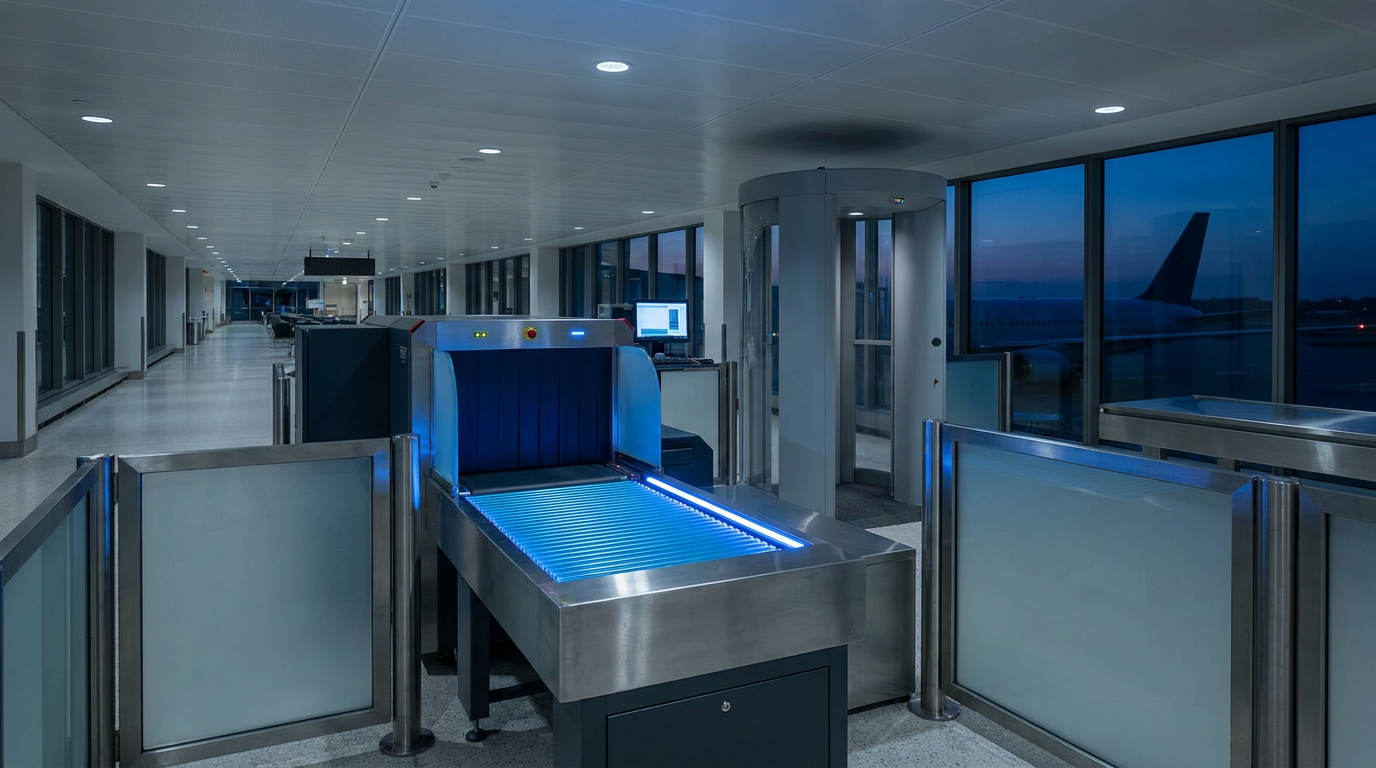
- That persons other than passengers, and the items they carry, are screened before entering security restricted areas, using methods capable of detecting explosives.
Staff screening, not only passenger screening, is therefore an explicit requirement. The Annex closed the "insider" gap by extending detection-capable screening to persons other than passengers.
What screening does Annex 17 require for passengers and baggage?
Screening is the act of applying technical or other means to detect weapons, explosives or other dangerous devices that could be used in an act of unlawful interference. Chapter 4 mandates it across every stream that reaches an aircraft.
For passengers and cabin baggage, the Chapter 4 passenger provisions require:
- That originating passengers and their cabin baggage are screened before boarding from a security restricted area.
- That screening methods are capable of detecting explosives and explosive devices, applied unpredictably where not applied continuously.
- That transfer passengers are screened, unless a validated one-stop arrangement confirms screening at origin and protection in transit.
- That screened passengers are protected from unauthorised interference until boarding, and re-screened if that protection is broken.
For hold baggage, the Chapter 4 hold-baggage provisions require originating hold baggage to be screened before loading, using explosive-detection-capable methods. The Twelfth Edition added a Standard on methods to detect explosives in hold baggage. Operators must not transport the baggage of a person who is not on board unless it is identified as unaccompanied and appropriately screened, which is the baggage-reconciliation rule.
How does Annex 17 secure cargo and mail?
Cargo and mail get their own regime in Chapter 4. The Chapter 4 cargo provisions require appropriate security controls, including screening where practicable, before cargo and mail are loaded onto a commercial aircraft.
The supply-chain machinery sits underneath that duty:
- Each State must establish a supply chain security process, including approval of regulated agents and known consignors.
- A regulated agent is an entity that conducts business with an operator and applies security controls accepted by the appropriate authority.
- A known consignor originates cargo for its own account under procedures meeting common security standards.
- Enhanced measures must apply to high-risk cargo and mail.
- A security status must accompany confirmed cargo, electronically or in writing, throughout the secure supply chain.
Operators must not accept cargo unless its screening is confirmed and accounted for by a regulated agent, a known consignor or an approved entity; otherwise it must be screened.
Does Annex 17 cover landside areas outside the security checkpoint?
Yes, and this is one of the newer expansions. The Chapter 4 landside provisions require each State to identify landside areas, and to establish security measures for them to mitigate and prevent acts of unlawful interference, in accordance with risk assessments.
Landside coordination is explicitly cross-referenced to the organisational Standards on national and airport coordination. The duty recognises that crowded public areas before the checkpoint, such as check-in halls and arrivals curbs, are themselves targets, even though they sit outside the sterile zone.
How does Annex 17 address cyber threats?
Cyber security entered the Annex as Standard 4.9.1. It requires each State to ensure that operators or entities, as defined in the NCASP, identify their critical information and communications technology systems and data used for civil aviation purposes, and develop and implement protective measures in line with a risk assessment.
A Recommended Practice in the cyber-threat provisions goes further, suggesting measures that protect the confidentiality, integrity and availability of those critical systems, including security by design, supply chain security, network separation, and limits on remote access. The Standard is deliberately outcome-based: it tells States to find their critical systems and protect them, without prescribing a single technical control set.
What does Annex 17 say about MANPADS?
The Chapter 4 aircraft provisions require each State, in line with a risk assessment by its national or local authorities, to ensure appropriate ground measures or operational procedures are established to mitigate possible attacks against aircraft using Man-Portable Air Defence Systems, known as MANPADS, and other similar weapons, at or near an airport. The threat is treated as a perimeter and approach-path problem, addressed through ground measures rather than onboard equipment alone.
What is the difference between an aircraft security check and a search?
Annex 17 draws a precise line between the two, and Chapter 1 defines each. An aircraft security check is an inspection of the interior of an aircraft to which passengers may have had access, plus the hold, to find suspicious objects. An aircraft security search is a thorough inspection of both interior and exterior.
The Chapter 4 aircraft provisions require that originating commercial aircraft receive either a check or a search, with the choice determined by a security risk assessment. The protected aircraft must then be safeguarded from unauthorised interference until departure. The check is the lighter, routine inspection; the search is the deeper one reserved for higher risk.
How does Annex 17 handle response to acts of unlawful interference?
Chapter 5 turns from prevention to management of response. It covers what States must do when an act of unlawful interference is threatened, underway or resolved.
On prevention within response, the Chapter 5 prevention provisions require States to:
- Safeguard an aircraft on the ground, and provide advance notification to relevant authorities, when reliable information indicates a possible act of unlawful interference.
- Search such an aircraft for concealed weapons or devices, with prior notification to the operator.
- Develop and regularly test contingency plans, with resources made available.
- Keep authorised, trained personnel ready to deploy at airports.
On response itself, the Chapter 5 response provisions require a State to protect the safety of passengers and crew of an affected aircraft on its territory, to relay flight information to other States responsible for air traffic services concerned, to assist an aircraft subjected to unlawful seizure, and to notify the State of Registry, the State of the Operator and ICAO. After resolution, States must provide ICAO with pertinent information and re-evaluate their security controls to prevent recurrence.
How does Annex 17 ensure security measures actually work?
A programme on paper is not enough; Annex 17 requires States to verify that controls work. The Chapter 3 quality-control provisions require each State to direct its appropriate authority to develop, implement and maintain a national civil aviation security quality control programme. The Twelfth Edition added a Standard outlining the essential elements of that programme.
That quality-control programme must regularly determine compliance with and validate the effectiveness of the NCASP, with priorities and frequency driven by risk assessment. It must include:
- Independence of those conducting oversight from those applying the measures.
- Personnel trained to appropriate standards with authority to obtain information and enforce corrective action.
- A confidential reporting system for security information from passengers, crew and ground personnel.
- A process to record and analyse results, identify causes and patterns of non-compliance, and verify that corrective actions are sustained.
The Annex defines its oversight instruments precisely. A security audit is an in-depth compliance examination of the whole NCASP; a security inspection examines a specific measure; a security test is a covert or overt trial simulating an unlawful act.
What background checks does Annex 17 require?
The quality-control provisions of Chapter 3 require background checks for three categories of person before they take up duties: those implementing security controls, those with unescorted access to security restricted areas, and those with access to sensitive aviation security information. A background check, per Chapter 1, covers identity, previous experience, criminal history and other relevant security information.
The duty does not end at hiring. Recurrent background checks must be applied at intervals defined by the appropriate authority, and anyone found unsuitable must immediately be denied the ability to implement controls or access restricted areas and sensitive information.
What training and security culture does Annex 17 require?
Chapter 3 makes training a Standard, not an aspiration. The Chapter 3 training provisions require a national training policy for all personnel involved in the NCASP, an assessment of competencies for initial and recurrent training, and a certification system ensuring instructors are qualified.
Specific competence Standards apply where the stakes are highest. Persons carrying out screening must be certified so that performance standards are consistently achieved. Personnel conducting audits, tests and inspections must be trained to appropriate standards. All personnel with NCASP responsibilities, and those with unescorted airside access, must receive initial and recurrent security awareness training.
The Twelfth Edition added a Recommended Practice on security culture, encouraging States to require entities to promote a strong and effective security culture. Chapter 1 defines security culture as the norms, values and attitudes reflected in the daily behaviour of everyone in an organisation. It is the human layer that makes the technical controls hold.
Frequently asked questions
Is Annex 17 legally binding?
Annex 17 binds Contracting States as Standards adopted under Article 37 of the Chicago Convention. States must apply its Standards or file a difference with ICAO under Article 38. It takes legal effect domestically through each State's own national civil aviation security programme and supporting law, so the binding force reaches operators and airports via national regulation rather than directly.
What is the difference between a Standard and a Recommended Practice?
A Standard is a specification whose uniform application is recognised as necessary, and to which States will conform; non-compliance triggers a compulsory notification to ICAO. A Recommended Practice is recognised as desirable, and States only endeavour to conform, with notification of differences merely invited. In the Annex, Standards are plain roman text and Recommended Practices carry the "Recommendation" prefix.
What is the difference between an aircraft security check and a search?
An aircraft security check, as defined in Chapter 1, is an inspection of the interior areas passengers could access plus the hold, to find suspicious objects. An aircraft security search is a thorough inspection of both interior and exterior. The Chapter 4 aircraft provisions require originating commercial aircraft to receive one or the other, with the choice set by a security risk assessment.
How does Annex 17 address cyber threats?
Standard 4.9.1 requires States to ensure that operators or entities identify their critical information and communications technology systems and data used for civil aviation, and implement protective measures in line with a risk assessment. An accompanying Recommended Practice suggests protecting confidentiality, integrity and availability through security by design, supply chain security, network separation and limited remote access.
Does Annex 17 require background checks for airport staff?
Yes. The quality-control provisions of Chapter 3 require background checks before a person implements security controls, gains unescorted access to security restricted areas, or accesses sensitive aviation security information. Recurrent checks must follow at intervals set by the appropriate authority, and anyone found unsuitable must immediately lose that access.
What is the NCASP?
The NCASP is the national civil aviation security programme required by Standard 3.1.1. It is the written national programme that safeguards civil aviation against acts of unlawful interference, and it is the reference every airport security programme and aircraft operator security programme must meet. ICAO's Aviation Security Manual (Doc 8973) provides implementation guidance for States building and maintaining their NCASP.