Air Cargo Security: How Air Freight Is Screened and Secured
Air cargo security uses screening and a regulated secure supply chain to keep dangerous items out of freight and mail on aircraft. Unlike passenger screening, it secures a chain of custody that begins at the shipper, not the airport.
On this page · 11
- What is air cargo security?
- Why does air cargo security matter?
- How is air cargo screened?
- What is the secure supply chain (regulated agents and known consignors)?
- How is air cargo security regulated?
- How does cargo security connect to threat intelligence?
- Frequently asked questions
- What is the difference between a regulated agent and a known consignor?
- Does all air cargo have to be screened?
- What is ACC3?
- Is cargo on passenger flights screened differently from freighter cargo?
Air cargo security is the set of regulated measures — screening, supply-chain controls and access restrictions — that prevent explosives, weapons or other dangerous items from being carried in freight and mail on aircraft. It is governed globally by ICAO Annex 17 and, unlike passenger screening, it secures a long commercial chain that begins at a shipper's warehouse, not the airport.
What is air cargo security?
Air cargo security is the cargo-and-mail branch of AVSEC. Its goal is narrow and specific: ensure that nothing shipped as freight can be used to attack an aircraft or be smuggled past controls. Every consignment loaded onto a commercial aircraft — whether a passenger flight carrying belly cargo or a dedicated freighter — must be either screened or shipped under a controlled, auditable supply chain.
This makes cargo a distinct problem from passenger and baggage screening. A passenger and their bag arrive together at a single checkpoint. A pallet of freight may pass through a forwarder, a trucking company, a consolidator and a handling agent before it reaches the aircraft. Securing cargo therefore means securing the chain, not just the final checkpoint.
Passenger screening protects one checkpoint. Cargo security protects a chain of custody that can stretch across continents before the freight ever sees an airport.
Why does air cargo security matter?
Cargo is an attractive vector precisely because it is not accompanied by a passenger who can be questioned or watched. The defining case is the October 2010 plot in which two explosive devices, concealed in printer toner cartridges, were shipped as air cargo from Yemen and addressed to destinations in the United States. According to the official accounts of that incident, the devices were intercepted at transit points in the United Kingdom and the United Arab Emirates after an intelligence tip — not by routine screening alone.
That plot reshaped global cargo policy. It exposed how dangerous goods could move through the express-freight system and drove regulators to tighten screening requirements and supply-chain vetting for cargo bound for, or transiting through, their territory.
How is air cargo screened?
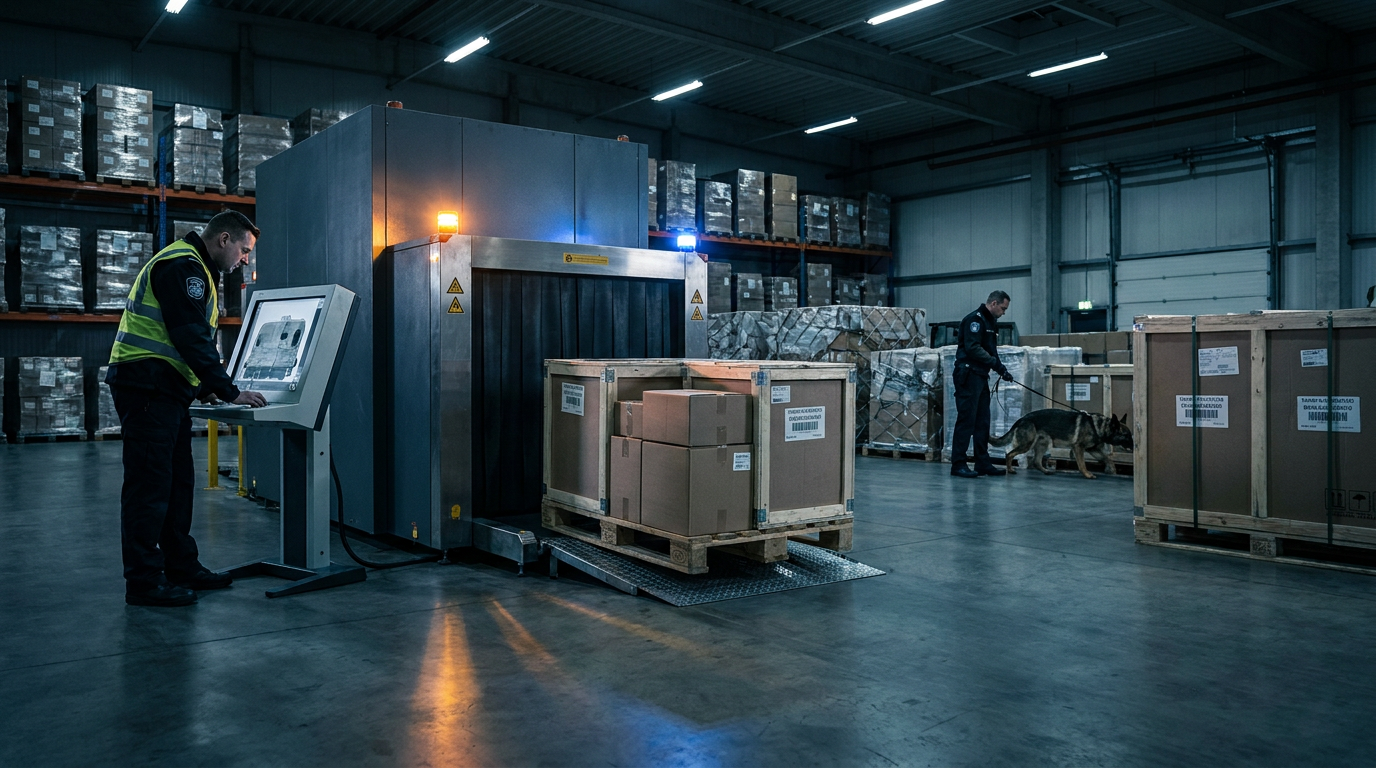
Annex 17 requires that cargo and mail be subjected to appropriate security controls before being loaded onto an aircraft. In practice, screening uses a combination of methods, chosen according to the consignment and the regulator's rules:
- X-ray and computed tomography (CT) imaging of packages and pallets.
- Explosive Detection Systems (EDS) and Explosive Trace Detection (ETD) swabbing.
- Explosive Detection Dogs (EDD) — increasingly accepted for large or dense consignments that defeat imaging.
- Physical search and visual inspection.
- Metal detection for specific item types.
No single method clears every shipment. Dense or large freight that an X-ray cannot penetrate may require trace detection, canine teams or breakdown and physical search. The regulator specifies which methods are acceptable for which cargo, and screening must be performed by certified equipment and trained, vetted staff.
What is the secure supply chain (regulated agents and known consignors)?
Screening every item at the airport would collapse the freight system, so the global model secures cargo upstream instead. This is the regulated-agent / known-consignor framework, and it is the heart of modern air cargo security.
- A regulated agent (a freight forwarder or handling agent) is approved by the national authority to apply security controls and maintain chain of custody. Cargo handled within this validated chain can be treated as secure without re-screening at every hop.
- A known consignor is a shipper approved to prepare cargo securely at its own premises. Freight from a known consignor enters the chain already secured, provided custody is unbroken.
- An account consignor is a more limited category whose cargo can travel only on all-cargo aircraft, not passenger flights.
The principle is secure once, then protect the chain. Once cargo is screened or originated by an approved party, the security task becomes protecting it from tampering until it is loaded — through tamper-evident sealing, vetted transport and access control.
How is air cargo security regulated?
The baseline is set by ICAO Annex 17, whose Standards and Recommended Practices every contracting state must implement through its National Civil Aviation Security Programme. Annex 9 and ICAO's Aviation Security Manual (Doc 8973, restricted) add operational detail.
States then build their own regimes on top of that baseline:
- The European Union sets detailed cargo rules in Regulation (EU) 2015/1998, including the ACC3 regime, which governs air cargo and mail carried into the EU from third-country airports. Under ACC3, an operator flying cargo into the EU must be designated and its security validated, and overseas regulated agents (RA3) and known consignors (KC3) must be independently validated.
- The United States, through the TSA, runs its own certified screening and supply-chain programmes for cargo on passenger and all-cargo aircraft.
The effect is that a single international shipment can sit under several overlapping regimes at once — the origin state's, the destination state's, and the airline's own programme.
How does cargo security connect to threat intelligence?
Screening and the secure supply chain are the procedural layer. They are strongest when directed by knowledge of where the threat is concentrated — which origin countries face elevated insider or interference risk, and which routes carry consignments through unstable regions.
This is where aviation security intelligence reinforces compliance. Regulatory controls define the floor every shipment must clear; intelligence tells an operator where to apply scrutiny above that floor. AeroVigil maps that picture as live, country-level flight risk profiles, so the question — which origins and routes warrant extra cargo scrutiny right now? — is answered from current signals rather than a static list. The two together — procedure plus threat picture — are what a mature aviation security programme looks like.
Procedures stop the last attack. Intelligence tells you where the next one is most likely to originate — and where in the cargo chain to look hardest.
Frequently asked questions
What is the difference between a regulated agent and a known consignor?
A regulated agent is an approved party in the transport chain (a forwarder or handler) that applies security controls and protects cargo in transit. A known consignor is an approved shipper that prepares cargo securely at its own premises so it enters the chain already secured. Both are validated by the national authority.
Does all air cargo have to be screened?
Cargo must either be physically screened or shipped under a validated secure supply chain that establishes it as secure. The secure-supply-chain model exists precisely so that not every consignment has to be screened at the airport — but cargo outside that chain must be screened before loading.
What is ACC3?
ACC3 (Air Cargo or Mail Carrier operating into the Union from a third-country airport) is the EU designation required for any operator carrying cargo or mail into the EU from outside it. It ties into validated overseas regulated agents (RA3) and known consignors (KC3).
Is cargo on passenger flights screened differently from freighter cargo?
The acceptable methods and consignor categories can differ. For example, account-consignor cargo is generally restricted to all-cargo aircraft, while cargo on passenger aircraft faces stricter controls because of the people on board.
Continue with What is AVSEC? for the wider security discipline, or ICAO Annex 17 requirements for the regulatory baseline behind cargo screening. For a role-by-role breakdown, see who is responsible for air cargo security and the regulated agent and known consignor explainer. The air cargo security glossary entry gives the quick definition.