Who Is Responsible for Air Cargo Security?
Air cargo security is a shared responsibility under ICAO Annex 17: the state sets the rules, and aircraft operators, regulated agents, and known consignors each secure their own link in the supply chain.
On this page · 14
- Who sets the rules for air cargo security?
- What is the aircraft operator responsible for?
- What is a regulated agent, and what are they responsible for?
- What is a known consignor?
- Who is responsible for screening high-risk cargo?
- How does the "secure supply chain" pass responsibility along?
- Who is responsible for transfer cargo?
- Where EU validation fits in
- Frequently asked questions
- Who is ultimately responsible for air cargo security?
- Is the airline or the shipper responsible for screening cargo?
- What is the difference between a regulated agent and a known consignor?
- Who screens high-risk cargo?
- Does a known consignor's cargo still get screened?
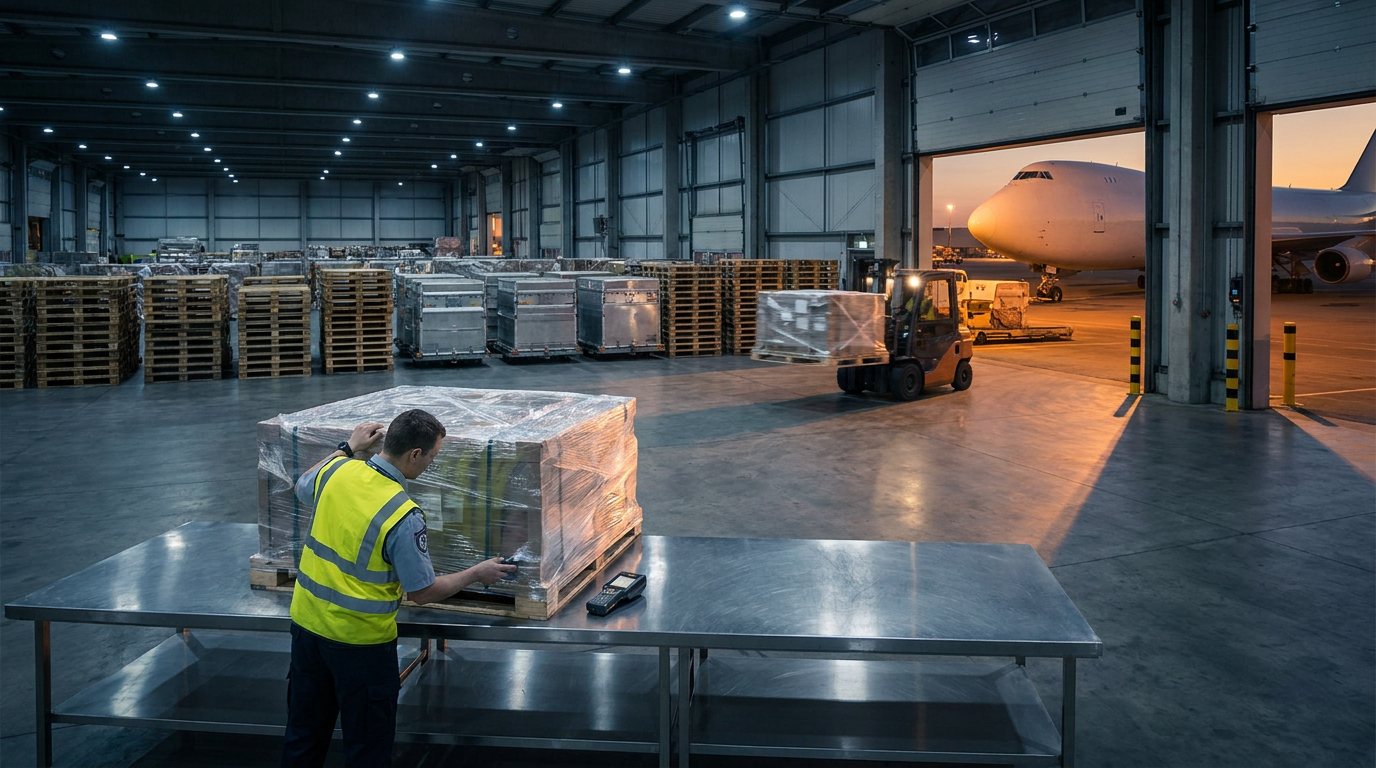
Air cargo security is a shared responsibility, not the job of any single company. Under ICAO Annex 17, a state's appropriate authority sets the rules, and a chain of accountable parties carries them out: the aircraft operator, the regulated agent, the known consignor, and the screeners acting on their behalf. Each party secures its own link in the supply chain and passes the consignment on with a verifiable security status, so responsibility travels with the freight from origin to aircraft.
This guide breaks down who does what, using the framework set by ICAO Annex 17 and its cargo provisions. For how the freight itself is screened, see the pillar guide on air cargo security.
Who sets the rules for air cargo security?
The state does. ICAO Annex 17 places the top-level obligation on each Contracting State, acting through its designated appropriate authority — usually the national civil aviation security regulator. That authority writes the national programme, approves who may handle secured cargo, and audits compliance.
In practice, these rules live in the country's National Civil Aviation Security Programme (NCASP). The NCASP defines the screening methods, the approval process for cargo operators, and the penalties for failure. Airlines, agents, and consignors do not design their own rules — they implement the standard the state has already set.
What is the aircraft operator responsible for?
The aircraft operator is responsible for the final acceptance decision. Annex 17 requires that operators do not load cargo or mail onto a commercial flight unless the required screening or security controls have been confirmed and accounted for. In other words, the airline is the last checkpoint before the freight reaches the aircraft.
The operator must also protect accepted cargo from unauthorized interference until departure. If the chain of custody is broken — a seal is missing, or the security status cannot be verified — the operator cannot load the consignment without re-screening it. This makes the airline the enforcer of everyone else's compliance.
What is a regulated agent, and what are they responsible for?
A regulated agent is a freight forwarder or handling entity that a state has approved to apply security controls to cargo. Annex 17 defines a regulated agent as an agent, freight forwarder, or other entity that conducts business with an operator and provides security controls accepted or required by the appropriate authority.
Regulated agents are responsible for screening cargo, or for accepting already-secured cargo from an approved source, and then protecting it. They are the working core of the secure supply chain, because most cargo is screened by agents rather than by airlines directly. A regulated agent that accepts cargo issues and maintains its security status so the next party can trust it.
What is a known consignor?
A known consignor is a shipper trusted to originate secure cargo. Annex 17 defines a known consignor as a consignor who originates cargo or mail for its own account and whose procedures meet common security rules sufficient to allow that cargo to be carried on any aircraft.
The known consignor's responsibility is to secure the cargo at the point of origin — the factory or warehouse — so it does not need to be screened again downstream. This is efficient but demanding: a known consignor must maintain approved premises, vetted staff, and tamper-evident packing. If those controls lapse, the consignor loses its status and its cargo becomes unknown cargo, which must then be screened.
Who is responsible for screening high-risk cargo?
High-risk cargo carries a higher, non-delegable duty. Annex 17 defines high-risk cargo or mail as consignments that pose a threat because of specific intelligence, or that show anomalies or signs of tampering. For these, the standard requires enhanced security measures beyond the routine baseline.
Responsibility for enhanced screening still sits with the party handling the consignment — the operator or regulated agent — but the appropriate authority sets what "enhanced" means. High-risk cargo cannot be cleared by supply-chain trust alone; it must be physically screened by appropriate methods before it is loaded.
How does the "secure supply chain" pass responsibility along?
Responsibility is transferred by a documented security status. Annex 17 requires that once cargo has been confirmed and accounted for, it is issued a security status that accompanies the consignment — electronically or in writing — throughout the secure supply chain.
This is the mechanism that lets responsibility move without gaps. Each party inherits secured cargo, adds its own controls, and hands off a consignment whose security status the next party can verify. The chain works only if every link is approved and every handoff is documented, which is why a single unapproved touchpoint can invalidate the whole movement.
Who is responsible for transfer cargo?
Transfer cargo is the easiest link to overlook. Annex 17 defines transfer cargo and mail as cargo departing on a different aircraft from the one it arrived on, and it requires that transfer cargo be subjected to appropriate security controls before it is loaded onward.
The operator and agents at the transfer point carry this responsibility. They cannot assume the origin controls still hold; they must confirm the security status or re-apply controls. Annex 17 also recommends that states establish mechanisms to confirm transfer cargo entering their territory was properly secured.
Where EU validation fits in
The ICAO framework is implemented regionally with named, auditable roles. In the European Union, the regulated agent and known consignor concepts become the RA3 and KC3 designations for third-country supply chains, feeding the ACC3 requirement for carriers flying cargo into the EU. For how those validations assign responsibility in practice, see ACC3, RA3 & KC3 explained.
Frequently asked questions
Who is ultimately responsible for air cargo security?
The Contracting State is ultimately responsible under ICAO Annex 17, acting through its appropriate authority. The state sets the rules and approves the operators, agents, and consignors who carry them out. Day-to-day, responsibility is shared across the secure supply chain.
Is the airline or the shipper responsible for screening cargo?
Both have duties. The shipper, if it is a known consignor, secures cargo at origin; the airline makes the final acceptance decision and cannot load cargo whose security controls are not confirmed. A regulated agent often performs the screening in between.
What is the difference between a regulated agent and a known consignor?
A regulated agent applies security controls to cargo from others as an approved handler, while a known consignor secures its own cargo at the point of origin. Both are approved by the appropriate authority, but the regulated agent screens or safeguards third-party cargo, and the known consignor vouches for its own.
Who screens high-risk cargo?
High-risk cargo must be screened by the handling operator or regulated agent using enhanced methods set by the appropriate authority. Supply-chain trust alone is not sufficient for high-risk consignments; they require physical screening before loading.
Does a known consignor's cargo still get screened?
Not routinely, as long as the known consignor maintains its approved status. Its cargo is secured at origin and travels with a security status. If that status cannot be verified, or the consignor loses approval, the cargo is treated as unknown and must be screened.