Ukraine and Russia FIR Military Activity: NATO and Allied Aircraft Intensify Presence as Kyiv-Kursk Conflict Continues
NATO surveillance platforms, allied military transports, and unidentified military aircraft have been detected inside Kyiv FIR repeatedly in the past week, as active armed conflict indicators for both Ukraine and Russian Kursk Oblast remain confirmed.
On this page · 10
- What Is Happening Now
- Military Aircraft Detected in Kyiv FIR This Week
- Implications for Civil Aviation
- The Kursk Dimension
- What Operators Should Watch
- Key Takeaways
- Frequently asked questions
- Can civil aircraft fly over Ukraine?
- What is the GNSS risk for flights near Ukraine?
- Which military aircraft were detected in Kyiv FIR this week?
What Is Happening Now
The Kyiv FIR (UKBV) and Moscow western FIR (UUWV) continue to operate under active armed conflict conditions, with fresh corroboration this week of inter-state conflict activity involving Russia and Ukraine over Kyiv and Kursk Oblast respectively. What distinguishes the current week's intelligence picture from general background noise is the simultaneous detection of multiple NATO and allied military aircraft transiting the Kyiv FIR — a pattern that reflects ongoing western military support operations and carries direct implications for civil airspace risk assessment.
Military Aircraft Detected in Kyiv FIR This Week
ADS-B monitoring across multiple polling windows has placed the following military-registered aircraft inside UKBV:
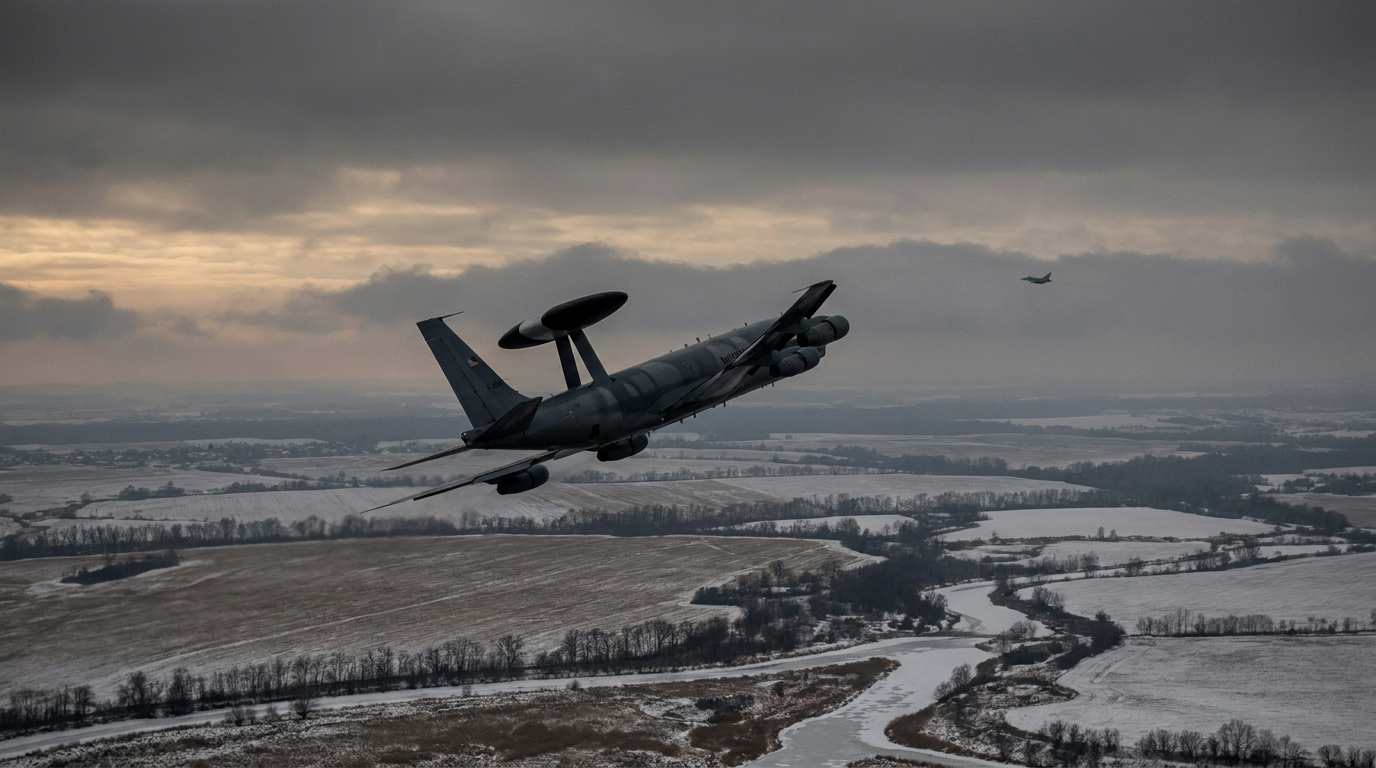
- NATO E-3A Sentry AWACS (LX-N90442, callsign NATO21) — detected on at least two separate occasions inside Kyiv FIR. The E-3 Sentry is NATO's primary airborne warning and control aircraft. Its repeated presence in UKBV is consistent with ongoing theatre surveillance and coordination roles.
- Dassault Rafale Marine (RFAL type, callsign REQUIN21) — a French Navy fighter detected inside UKBV. The REQUIN ("Shark") callsign series is associated with French naval aviation. Fighter presence in the FIR is operationally significant.
- Cessna Citation CL60 (N159L, callsign BRIO66) — an aircraft of the type used extensively for intelligence, surveillance, and reconnaissance (ISR) missions, registered in the US civil registry but operating under a structured military-style callsign.
- Beechcraft King Air BE20 (84-00488, callsign DUKE62) — another platform commonly used for ISR and special operations support, detected inside UKBV.
- German Air Force Gulfstream GL5T (14+03, callsign GAF631) — a Luftwaffe VIP/liaison transport operating inside the FIR.
- Polish military PZL M28 (SP-44YG, callsign SN44YG) — a Polish military transport detected in UKBV, consistent with ongoing logistical support to Ukraine.
In parallel, a Tupolev Tu-204 (RA-64521, callsign RSD661) was detected inside Moscow FIR (UUWV), which sits alongside the confirmed active armed conflict indicator for Kursk Oblast.
Implications for Civil Aviation
Commercial aviation has largely avoided Ukrainian airspace since February 2022, and the evidence here is consistent with that picture — the aircraft detected in UKBV are overwhelmingly military or state platforms, not commercial operators. However, several operational and risk-planning considerations remain relevant:
Adjacent FIR contamination: The conflict dynamics in UKBV and UUWV create spillover risk for adjacent FIRs — particularly Kyiv's neighbours in Poland, Moldova, Romania, and Hungary. GNSS jamming and spoofing events documented in the broader region remain a persistent concern for commercial operators flying in these areas, even if they are not entering Ukrainian airspace directly.
Airspace complexity for allied military operators: The density of NATO and allied military aviation inside UKBV — including fighter, AWACS, ISR, and transport types simultaneously — creates a complex and dynamic airspace environment. Any commercial operator contemplating a relief, medical, or governmental flight into Ukraine must account for a heavily militarised airspace with non-standard ATC interaction.
Escalation watch: The presence of a French naval fighter (Rafale Marine, REQUIN21) and NATO AWACS inside Kyiv FIR in the same week as confirmed active armed conflict over Kyiv itself is an indicator of elevated operational tempo. Operators and insurers should treat this as a signal that the conflict environment is not de-escalating.
Russian airspace: The UUWV armed conflict indicator, specifically citing Kursk Oblast, remains active with military force, small-arms fire, and artillery as drivers. Russian airspace west of Moscow should continue to be treated as off-limits for all commercial operators, consistent with the sanctions-driven closures already in place.
The Kursk Dimension
The Kursk Oblast signal is a reminder that the conflict's geographic footprint on the Russian side remains active. Ukrainian drone and ground incursion activity in Kursk Oblast has been reported across multiple news cycles in recent months. For operators transiting Finnish, Baltic, or Polish airspace, awareness of potential air-defence spillover — including misidentification risk and GNSS disruption — remains a live planning consideration, particularly for lower-altitude or slower aircraft.
What Operators Should Watch
- GNSS degradation notices for Polish, Baltic, Finnish, and Romanian airspace, which have all experienced documented interference events linked to the broader Russia-Ukraine conflict environment.
- NATO NOTAM activity — large-scale NATO exercises or surge operations in the region can trigger temporary airspace restrictions that affect commercial routing at short notice.
- Any changes to UKBV airspace status — while civil aviation is not currently operating scheduled services into Ukrainian airspace, cargo, humanitarian, and governmental operators occasionally seek entry, and the current military density makes that a high-risk proposition.
- Tupolev Tu-204 movements in UUWV — Russian state aviation continuing to operate in Moscow FIR amid active conflict conditions is noted; operators with any residual Russian routing exposure should maintain awareness.
Key Takeaways
- Active armed conflict indicators remain confirmed for both Kyiv FIR (UKBV) and Kursk Oblast within Moscow FIR (UUWV) this week.
- NATO E-3A AWACS, a French Navy Rafale, ISR aircraft, and allied military transports have all been detected inside UKBV in the past seven days — indicating elevated allied military operational tempo.
- The conflict environment in and around Ukrainian airspace is not de-escalating based on current evidence.
- GNSS interference risk in adjacent FIRs (Poland, Baltics, Romania) remains a persistent operational concern for commercial operators in the region.
- Any non-scheduled commercial, cargo, or government flight into Ukrainian airspace should be subject to the most rigorous pre-flight security and risk assessment, given the current military traffic density.
Frequently asked questions
Can civil aircraft fly over Ukraine?
Commercial aviation has largely avoided Ukrainian airspace since February 2022. The aircraft detected inside Kyiv FIR (UKBV) are overwhelmingly military or state platforms, and any non-scheduled entry warrants the most rigorous pre-flight security and risk assessment.
What is the GNSS risk for flights near Ukraine?
GNSS jamming and spoofing documented across Polish, Baltic, Finnish and Romanian airspace remain a persistent concern for commercial operators in adjacent FIRs, even when they are not entering Ukrainian airspace directly.
Which military aircraft were detected in Kyiv FIR this week?
ADS-B monitoring placed a NATO E-3A AWACS, a French Navy Rafale, ISR platforms and allied military transports inside UKBV across multiple polling windows over seven days, indicating elevated allied military operational tempo.
The AeroVigil Airspace Risk Desk publishes analysis under AeroVigil's editorial standard: every hard claim is attributed to a named source or AeroVigil's own data pipeline, and no statistics are invented. See our methodology for how sources are graded and verified.