Baltic GPS Jamming in 2025: A GNSS Integrity Case Study
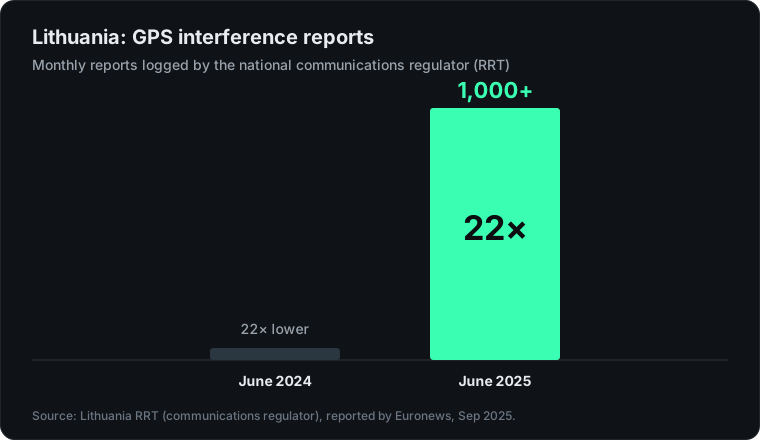
GPS jamming over the Baltic became routine in 2025. Lithuania logged more than 1,000 interference reports in June alone — 22 times the prior year — and jamming has already forced scheduled flights to divert.
On this page · 15
- What is happening to GPS over the Baltic?
- Which countries are most affected?
- The Finnair Tartu diversions: when jamming grounds a route
- Who is behind it, and from where?
- Jamming or spoofing — and why the difference matters
- How big is the global picture?
- What does this mean for flight risk assessment?
- What are regulators doing about it?
- Key takeaways
- Frequently asked questions
- Is it safe to fly through GPS jamming over the Baltic?
- What is the difference between GPS jamming and spoofing?
- Who is causing the Baltic GPS interference?
- How does GPS jamming affect flight planning?
- Is GPS jamming getting worse?
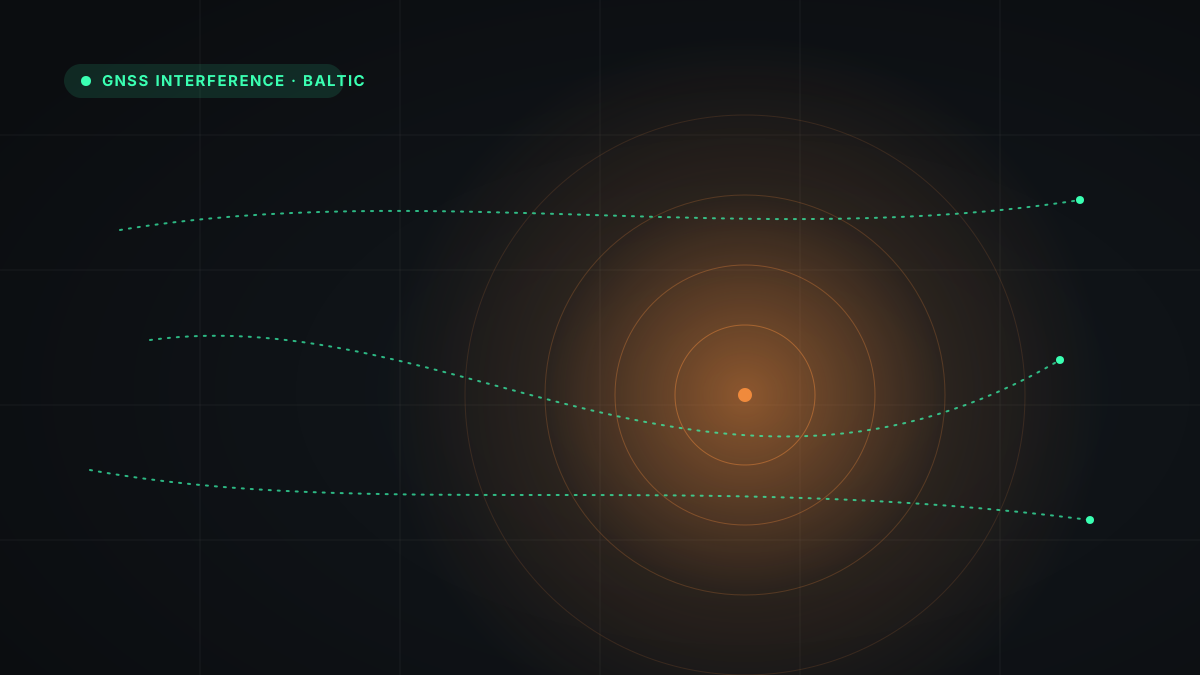
GPS jamming over the Baltic region became a routine operating condition in 2025, not an occasional anomaly. Lithuania's national communications regulator logged more than 1,000 GPS interference reports in June 2025 alone — 22 times the number recorded in June 2024, according to figures reported by Euronews. The disruption is concentrated around Kaliningrad and has been attributed by Baltic governments to Russian electronic-warfare activity. It has already forced scheduled flights to divert. This case study examines what the data shows, how jamming differs from spoofing, and what both mean for navigation integrity and pre-flight risk assessment.
What is happening to GPS over the Baltic?
Aircraft crossing the Baltic now routinely lose trustworthy satellite positioning. The interference falls into two distinct categories. Jamming overpowers the GNSS signal so the receiver loses its position fix entirely. Spoofing transmits false signals so the receiver computes a wrong position or time while still believing the data is valid. The Baltic theatre is predominantly a jamming environment, driven by ground-based electronic-warfare systems near Kaliningrad.
The growth has been steep. Lithuania's communications regulator (RRT) recorded more than 1,000 GPS interference reports in June 2025, a 22-fold increase over June 2024, per reporting by Euronews in September 2025.
This is not a single-country problem. It tracks the geography of the electronic-warfare source rather than any one national border.
Which countries are most affected?
The interference radiates outward from the southeastern Baltic. Lithuanian authorities have warned that GPS can be disrupted up to roughly 450 kilometres from Kaliningrad, which places several capitals and busy approach corridors inside the affected zone.
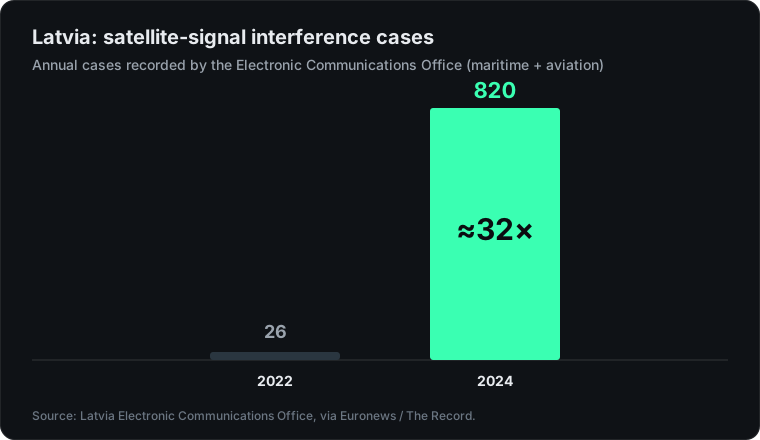
Latvia's Electronic Communications Office recorded 820 cases of satellite-signal interference in 2024, compared with just 26 in 2022 — a roughly thirty-fold rise over two years, as reported by Euronews and The Record. These figures cover maritime as well as aviation interference, but the trend line is unambiguous.
Poland reported 2,732 cases of GPS jamming and spoofing in January 2025, according to figures cited by Euronews. Estonian authorities have stated that a large share of flights in their airspace experience GPS interference, though the precise figure is reported without a named issuing agency and should be treated as an official estimate rather than an audited statistic.
The Finnair Tartu diversions: when jamming grounds a route
The clearest operational consequence to date came in Estonia. In April 2024, two Finnair flights bound for Tartu returned to Helsinki because GPS jamming prevented the GNSS-dependent approach into the airport, according to ERR News and AeroTime.
Finnair, the sole international carrier serving Tartu, then suspended its daily Helsinki–Tartu service from 29 April to 31 May 2024. The pause gave the airport time to implement an alternative approach procedure that did not rely on GPS. This is the defining lesson of the episode: jamming does not need to cause an accident to impose a cost — denying a single approach type can suspend an entire route.
Who is behind it, and from where?
Attribution, as stated by officials, points consistently to Russia. The foreign ministers of Estonia and Lithuania jointly described the interference as a "hybrid attack" in late April 2024, and Estonia summoned the Russian envoy in May 2024. Independent technical analysis supports a Kaliningrad-centred origin: a Spire Global assessment in October 2024 found aircraft in the primary interference zone experiencing position errors exceeding 30 metres, with complete GNSS collapse in the worst-affected cases.
Caution on attribution is itself part of good methodology. When an aircraft carrying European Commission President Ursula von der Leyen experienced reported GPS problems on approach to Plovdiv, Bulgaria, in August 2025, the initial "jamming" narrative was partly walked back: Bulgarian officials later said there was no evidence of prolonged interference, and Flightradar24 noted the aircraft showed good GPS signal quality throughout the flight. The episode is a reminder to separate confirmed interference data from rapid political attribution.
Jamming or spoofing — and why the difference matters
For flight operations, spoofing is the more dangerous of the two. Per EASA Safety Information Bulletin 2022-02 (revision 3, July 2024), spoofing is harder to detect, can corrupt multiple onboard systems at once, and has triggered false terrain-proximity warnings that prompted unwarranted climbs. A jammed receiver knows it has lost the signal; a spoofed receiver is confidently wrong.
Globally, spoofing is the faster-growing threat. The OPSGROUP GPS Spoofing WorkGroup reported in September 2024 that spoofing rose roughly 500% during 2024, with the number of flights spoofed per day climbing from about 300 in early 2024 to roughly 1,500 at peak.
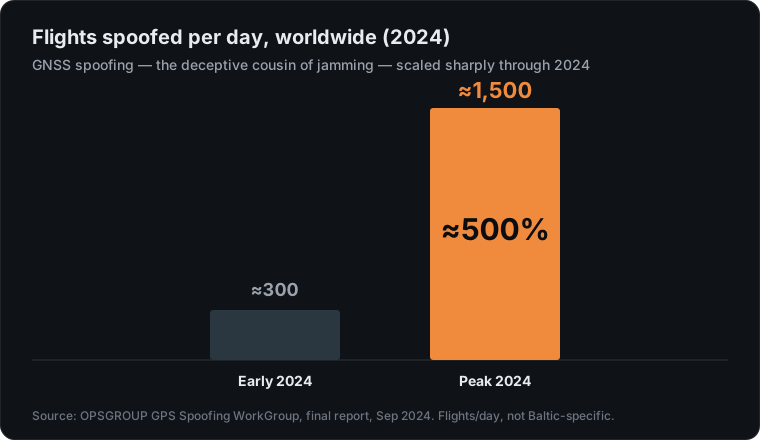
Independent measurement by SkAI Data Services and ZHAW tells the same story, with affected flights rising from a few dozen per day in February 2024 to more than 1,100 per day by August 2024. The Baltic remains primarily a jamming theatre; the heaviest spoofing has clustered over the Middle East, the Black Sea and the eastern Mediterranean. A complete navigation-threat picture has to hold both patterns at once.
How big is the global picture?
The airline-data view confirms the trend is structural, not seasonal. IATA reported in June 2025 that GPS signal-loss events rose 220% between 2021 and 2024, drawing on its GADM Flight Data eXchange. That figure is grounded in operators' own flight data, which makes it one of the more reliable measures available.
What does this mean for flight risk assessment?
GNSS interference is now a standing input to pre-flight planning, not an edge case. A route that crosses the Baltic should be assessed for navigation integrity the same way a conflict-zone overflight is assessed for threat. The operational questions are concrete: does the destination have a non-GNSS approach, are crews briefed on jamming-prone segments, and is the time-and-position risk reflected in the flight risk assessment?
This is exactly the gap AeroVigil's platform is built to close — turning raw interference and incident data into a decision-ready signal that dispatchers and security teams can act on before pushback, rather than after a diversion.
What are regulators doing about it?
The institutional response accelerated through 2025. EASA and IATA published a joint action plan on GNSS interference in June 2025, structured around four pillars: enhanced reporting, prevention and mitigation, infrastructure management, and coordination and preparedness. EASA and EUROCONTROL had earlier published a joint plan for safe operations during GNSS interference in March 2025. The regulatory direction is consistent: treat GNSS interference as a permanent feature of the operating environment and build resilience rather than wait for it to subside.
Key takeaways
- Baltic GPS jamming is now routine, not exceptional. Lithuania logged more than 1,000 interference reports in June 2025 — 22 times the prior year (RRT, via Euronews).
- Interference already grounds routes. Finnair suspended Helsinki–Tartu service for a month in 2024 after jamming denied the GPS approach (ERR News).
- Spoofing is the faster-growing and more dangerous threat globally, up roughly 500% in 2024 (OPSGROUP), even as the Baltic stays a jamming theatre.
- The trend is structural. IATA recorded a 220% rise in GPS signal-loss events from 2021 to 2024 (GADM FDX).
- Navigation integrity belongs in the FRAT. A Baltic crossing needs the same pre-flight scrutiny as a conflict-zone overflight.
Frequently asked questions
Is it safe to fly through GPS jamming over the Baltic?
Yes — commercial aircraft are designed to fly safely without GPS, using inertial reference systems and ground-based navigation aids as backups. The operational risk is not loss of control but loss of capability: jamming can deny a GPS-based approach, force a diversion, or increase crew workload. The Finnair Tartu suspension in 2024 shows the cost is real even when safety margins hold.
What is the difference between GPS jamming and spoofing?
Jamming blocks the satellite signal so the receiver loses its position fix and knows it has lost it. Spoofing transmits false signals so the receiver computes a wrong position while believing it is correct. Per EASA SIB 2022-02, spoofing is the greater operational risk because it is harder to detect and can mislead multiple aircraft systems at once.
Who is causing the Baltic GPS interference?
Baltic governments, including Estonia and Lithuania, have attributed the interference to Russian electronic-warfare systems and described it as a "hybrid attack." Independent technical analysis points to a source near Kaliningrad. Attribution should still be handled carefully, as some high-profile incidents have been over-attributed before the data was confirmed.
How does GPS jamming affect flight planning?
It makes navigation integrity a standing pre-flight input. Operators need to know whether a destination offers a non-GNSS approach, which route segments are jamming-prone, and how that risk feeds the flight risk assessment. Treating interference as a routine planning factor — rather than a surprise — is the core operational shift.
Is GPS jamming getting worse?
Yes. IATA recorded a 220% rise in GPS signal-loss events between 2021 and 2024, and Lithuania's June 2025 reports were 22 times higher than a year earlier. Global spoofing rose roughly 500% during 2024 according to OPSGROUP. Every reliable dataset points in the same direction.