Delta Flight 1076 Struck by Firework on Approach to Chicago Midway: A Reminder of Low-Altitude External Threat to Aircraft
A Delta Air Lines Airbus A319 was struck by a firework while on final approach to Chicago Midway Airport on 4 July, highlighting the underappreciated risk that improvised pyrotechnics and uncontrolled ground-launched projectiles pose to aircraft in terminal phases.
On this page · 10
- The Incident
- Why Terminal-Phase Aircraft Are Vulnerable
- Historical Context and Regulatory Environment
- Threat Escalation Consideration: From Fireworks to Deliberate Projectiles
- Operational and Planning Implications
- Key Takeaways
- Frequently asked questions
- Was Delta Flight 1076 damaged by the firework strike?
- Why are aircraft on final approach vulnerable to ground-launched projectiles?
- How can operators reduce firework-strike risk at urban airports?
The Incident
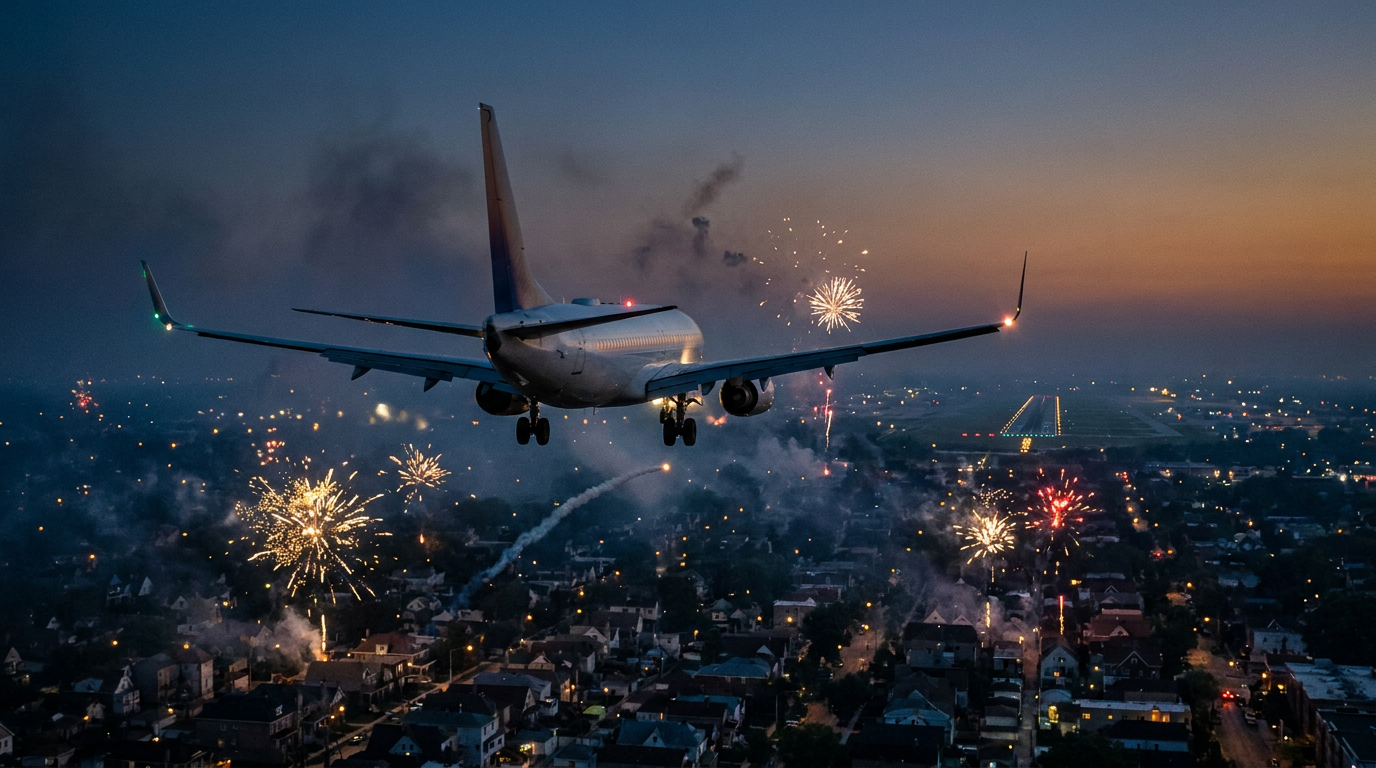
On 4 July — US Independence Day — a Delta Air Lines Airbus A319 operating as Flight 1076 was struck by a firework while on final approach to Chicago Midway International Airport (MDW). Multiple US and international media outlets reported that passengers aboard heard a loud bang, consistent with an external impact during the approach phase. The aircraft landed without further incident and no serious injuries were reported, but the event has prompted discussion about the risk profile of low-altitude aircraft operations near densely populated urban areas during high-fireworks-activity periods.
This incident is notable not because it represents a novel threat category, but because it illustrates a real and recurring vulnerability that is frequently underweighted in standard threat assessments: the risk to commercial aircraft from unguided, ground-launched pyrotechnics and similar improvised projectiles during approach and departure.
Why Terminal-Phase Aircraft Are Vulnerable
Final approach is one of the most constrained phases of flight from both a crew workload and a manoeuvrability perspective. Aircraft on final approach to major airports:
- Are flying at relatively low altitudes — typically 1,000–3,000 feet AGL in the last few miles before touchdown.
- Are following a fixed, predictable flight path (the instrument approach procedure or visual glideslope) that is publicly knowable.
- Are operating with landing lights, navigation lights, and other visual signatures that make them conspicuous from the ground.
- Have limited ability to deviate laterally or vertically without coordination with ATC.
Commercial fireworks — and even consumer-grade fireworks — can reach altitudes of 200–1,000 feet, while professional display shells can exceed 1,500 feet. At major urban airports surrounded by residential areas, the overlap between firework trajectories and approach paths is not trivial, particularly on known high-fireworks dates such as US Independence Day, New Year's Eve, Diwali, or national celebrations in various jurisdictions.
Historical Context and Regulatory Environment
This is not the first time an aircraft has been struck by pyrotechnics on approach. The US Federal Aviation Administration (FAA) has long-standing regulations governing fireworks displays near airports and approach paths, including requirements for local authority notifications and temporary flight restrictions (TFRs) during major events. However, the enforcement of these provisions — particularly regarding informal, residential-area fireworks — is inherently limited.
Chicago Midway sits in a densely urban environment on the southwest side of Chicago. Its approach paths pass over residential neighbourhoods where both permitted and unpermitted fireworks use is common on 4 July. The airport is not unique in this respect; many major airports in North American and European cities share similar geographic profiles.
The challenge for aviation security and safety planners is that this threat sits at the intersection of security (deliberate or reckless discharge of a projectile toward an aircraft) and safety (accidental trajectory overlap). In most jurisdictions, striking an aircraft with a firework — whether deliberate or not — constitutes a serious criminal offence, but prosecution depends on identifying the source, which is rarely achievable in a densely populated fireworks-active environment.
Threat Escalation Consideration: From Fireworks to Deliberate Projectiles
For aviation security professionals, the Delta Flight 1076 incident is a useful prompt to revisit the broader category of ground-launched projectile threats to low-altitude aircraft. The threat spectrum runs from:
- Accidental fireworks strikes (as in this incident) — unintended, but capable of causing windshield damage, engine ingestion events, or crew distraction at a critical flight phase.
- Deliberate laser illumination — a persistent and well-documented threat to crews on approach worldwide, causing temporary vision impairment.
- Signal flares and distress rockets — occasionally discharged in urban areas, with trajectories capable of reaching approach altitudes.
- Man-portable air defence systems (MANPADS) — the most severe end of the spectrum, representing the deliberate targeting of low-altitude commercial aircraft. While no MANPADS incident has occurred at a Western airport in the commercial era, the threat informs security planning at major hubs globally.
- Consumer and commercial drones — increasingly present in approach corridors, as evidenced by repeated near-miss reports at major airports.
The fireworks strike on Delta 1076 does not by itself indicate a security threat in the MANPADS sense. However, it is a concrete reminder that the airspace immediately around airports is not sterile, and that the terminal phase of flight carries an external threat dimension that deserves continued attention in both security planning and regulatory enforcement.
Operational and Planning Implications
For airline operations centres and security planning teams:
- Calendar awareness: Major fireworks dates — US Independence Day, New Year's Eve, local national celebrations, Diwali — should trigger a review of TFR compliance, approach path exposure, and crew briefings for affected airports.
- Urban airport profiles: Airports surrounded by residential areas are inherently more exposed. Route planning and slot management for these dates at high-exposure airports is worth reviewing.
- Crew reporting: Encourage crews to report any suspected external impact or unusual sound events during approach, even if no damage is immediately apparent. Post-flight inspection protocols should reflect the possibility of strike damage that is not immediately crew-visible.
- Regulatory engagement: Operators with significant exposure at urban airports may wish to engage with local airport authorities and aviation regulators about TFR enforcement and public communication campaigns ahead of known high-fireworks dates.
- Incident documentation: Where a strike is suspected, preserve ADS-B track data and ATC recordings — these can assist in reconstructing the ground origin zone and supporting any enforcement action.
Key Takeaways
- A Delta A319 on approach to Chicago Midway was struck by a firework on 4 July, with the impact heard by passengers inside the cabin. The aircraft landed safely.
- Final-approach aircraft are predictable, low-altitude, and visually conspicuous — characteristics that create inherent vulnerability to ground-launched projectiles, whether accidental or deliberate.
- The threat spectrum from this category of event ranges from accidental pyrotechnic strikes to deliberate MANPADS — the Delta incident sits at the benign end but illustrates genuine vulnerability.
- Operators at urban airports should incorporate major fireworks dates into operational risk calendars and ensure TFR and crew briefing protocols are in place.
- Post-flight inspection after any suspected impact — even if no damage is immediately apparent — should be standard procedure.
Frequently asked questions
Was Delta Flight 1076 damaged by the firework strike?
The Airbus A319 landed safely at Chicago Midway on 4 July and no serious injuries were reported, though passengers heard a loud impact during final approach.
Why are aircraft on final approach vulnerable to ground-launched projectiles?
Final-approach aircraft fly at low altitude — typically 1,000–3,000 feet AGL in the last few miles — follow a fixed, publicly knowable path, and are visually conspicuous, with limited ability to deviate without ATC coordination.
How can operators reduce firework-strike risk at urban airports?
Operators should add major fireworks dates to operational risk calendars, verify temporary flight restriction (TFR) compliance, brief crews, and inspect aircraft after any suspected impact even when no damage is immediately visible.
The AeroVigil Threat Intelligence Desk publishes analysis under AeroVigil's editorial standard: every hard claim is attributed to a named source or AeroVigil's own data pipeline, and no statistics are invented. See our methodology for how sources are graded and verified.